Honing vs. Sharpening a Knife: What Each One Does
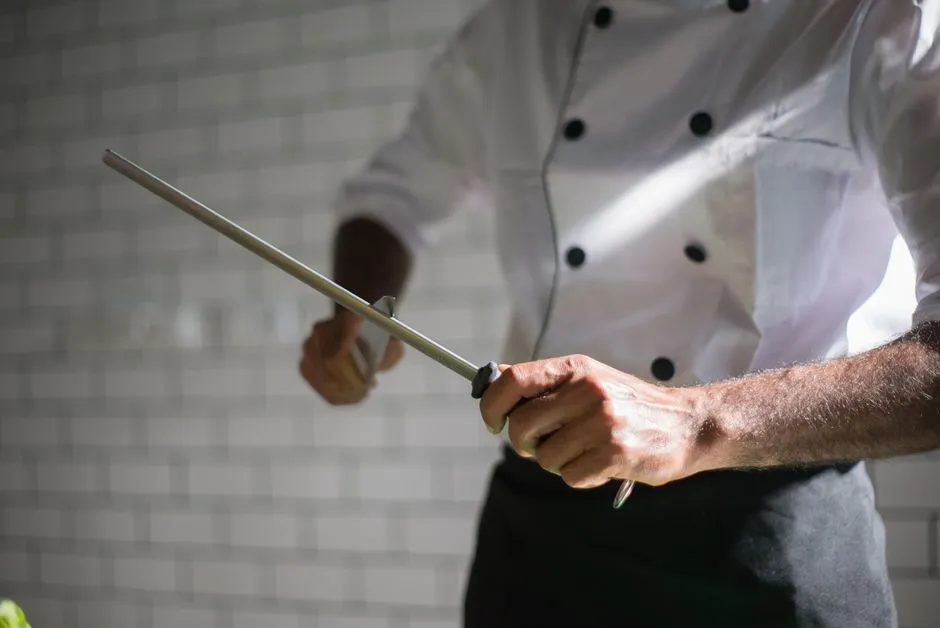
Honing maintains alignment; sharpening reshapes the edge
Honing and sharpening solve different edge problems. Honing uses a suitable rod or abrasive to maintain or refine an edge with very limited material removal, while sharpening deliberately removes material to form a new apex. A knife that has merely lost some crisp alignment may respond to careful honing; a rounded, chipped, or truly dull edge needs sharpening or professional repair.
Both operations involve an exposed blade. Work on a stable surface, keep fingers out of the path, use controlled strokes, and follow the knife and tool manufacturers’ instructions.
Understand what happens at the apex
The apex is the narrow line where the two sides of the blade meet. Normal use can leave that line less keen through wear, deformation, small damage, or a combination of changes. You cannot reliably diagnose every edge by glancing at it from across the kitchen while holding a tomato accusingly.
Honing is commonly used as maintenance between full sharpenings. Depending on the honing tool and abrasive, it may realign and refine the edge and may remove some material. It is not accurate to say that every honing tool removes no steel.
Sharpening uses an abrasive stone, plate, belt, wheel, or other system to remove enough material to create a new apex. That makes it the appropriate category when the edge geometry must be restored, but unnecessary sharpening also consumes blade material.
Compare the practical clues
| Observation | Try first | Why |
|---|---|---|
| Edge recently cut well but now feels slightly less crisp | Careful honing if the knife permits it | Maintenance may restore useful alignment or refinement |
| Edge reflects light along a rounded section | Sharpening | A rounded apex needs material removed |
| Visible chip or damaged tip | Professional assessment or controlled repair | Damage may require geometry work beyond routine maintenance |
| Knife remains dull after correct honing | Sharpening | Honing cannot rebuild a worn apex indefinitely |
| Specialty or asymmetric edge is unfamiliar | Manufacturer guidance or professional sharpener | The intended geometry may require a specific method |
These clues are not a license to run a fingertip along the edge. Inspect under good light and use safe cutting tests appropriate to the knife and your skill.
Know what a honing rod can and cannot do
Honing rods vary. Smooth, grooved, ceramic, and diamond-coated tools do not behave identically, and their suitability depends on the knife steel, hardness, edge geometry, and manufacturer guidance. An aggressive abrasive rod can remove more material than a smooth maintenance steel.
Use a rod longer enough for the blade to travel safely and a method that keeps the tip controlled. A vertical technique with the rod tip secured on a nonslip board can feel more manageable than fast airborne strokes. Keep the blade moving away from the supporting hand.
There is no universal honing angle. Match the knife’s intended edge as closely and consistently as the tool allows. If the correct geometry is unknown, consult the maker or a professional rather than choosing an impressive-sounding number.
Explore more maintenance decisions in edge care.
Recognize when sharpening is due
Sharpen when the edge no longer performs its normal task after appropriate cleaning and careful honing, or when inspection shows a worn apex. A knife that slips on food, crushes instead of slices, or needs unsafe force is asking for attention, though technique and cutting surface should also be checked.
Chips, bent tips, deep corrosion, loose handles, and cracks are not routine sharpening problems. Stop using a structurally questionable knife and seek qualified repair or replacement guidance.
Our whetstone sharpening guide explains a controlled hand method for suitable kitchen knives.
Avoid turning maintenance into damage
More pressure and more strokes are not automatically better. Excessive force can make angle control worse, increase wear, and create a slip hazard. Clean the knife and tool as directed, stabilize the setup, and use deliberate passes.
Do not use the side of a moving powered grinder without training or assume any shop machine is suitable for a finished kitchen edge. Powered abrasives can remove metal and generate heat quickly. Valuable, thin, laminated, highly hardened, serrated, or asymmetric blades may be better handled by a specialist.
The simple distinction remains useful: hone to maintain a suitable edge; sharpen to rebuild one. Diagnose first, choose the least aggressive correct process, and let consistency do the work that television chefs sometimes assign to speed.